Poetry Saves Lives. Yes, Really.
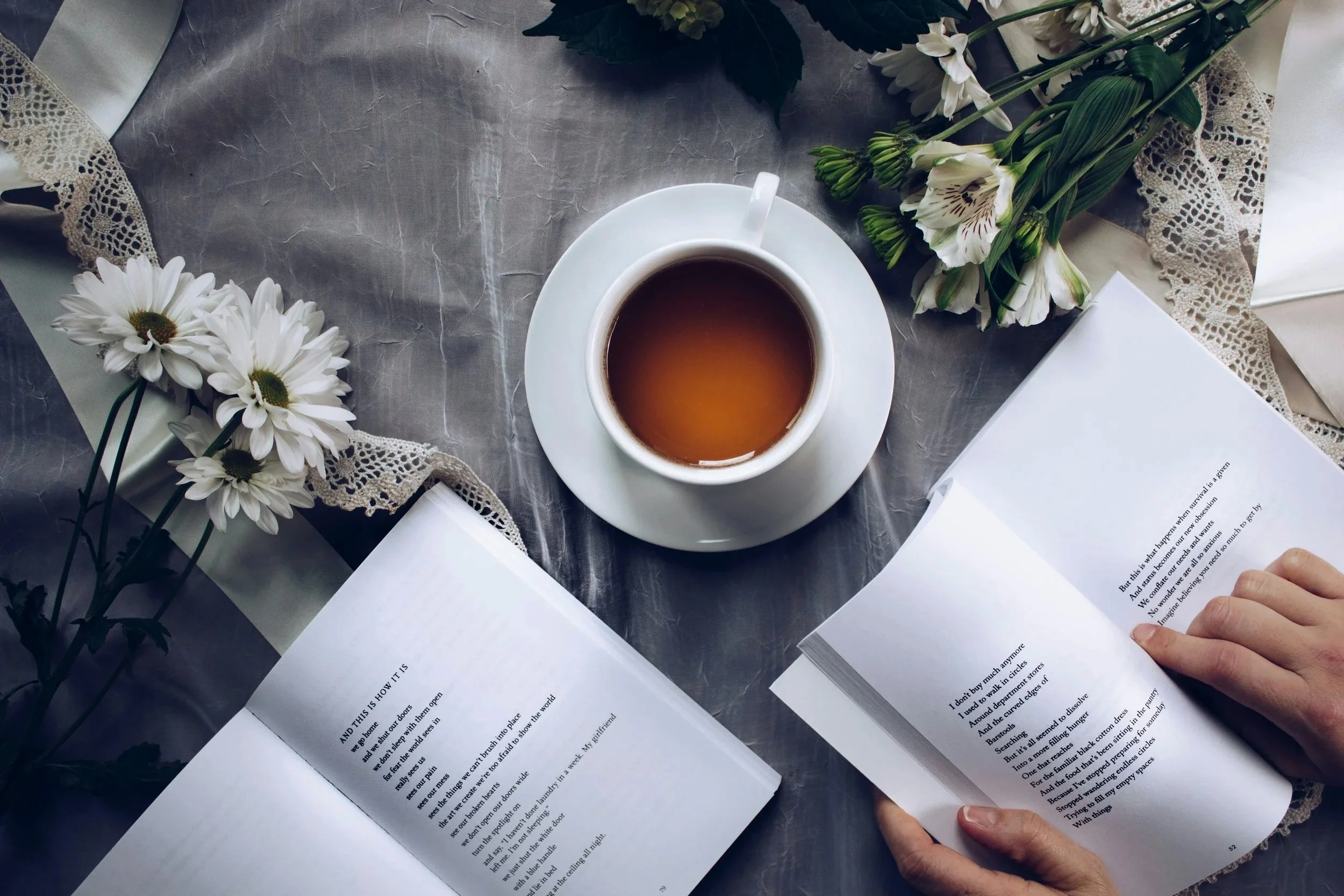
Photo by Thought Catalog on Unsplash
I walk out into the middle of the classroom. My students surround me in a Socratic arrangement. The room is dimly lit. Sparkling twinkle-lights hang from the windows that look out over the hundred-year-old oak trees. There is a hush that falls over my otherwise boisterous AP students.
I have their attention, so it’s time for me to begin:
“Two roads diverged in a yellow wood...” I say, filling the room with my best Frost-esque voice.
Then I pause to hold their eyes. They lean forward over their small yellow desks in attention.
This isn’t how class typically begins. But today is different. It’s the beginning of our Poetry Unit, and this might be the closest our classroom comes to resurrecting the lore of Dead Poets Society.
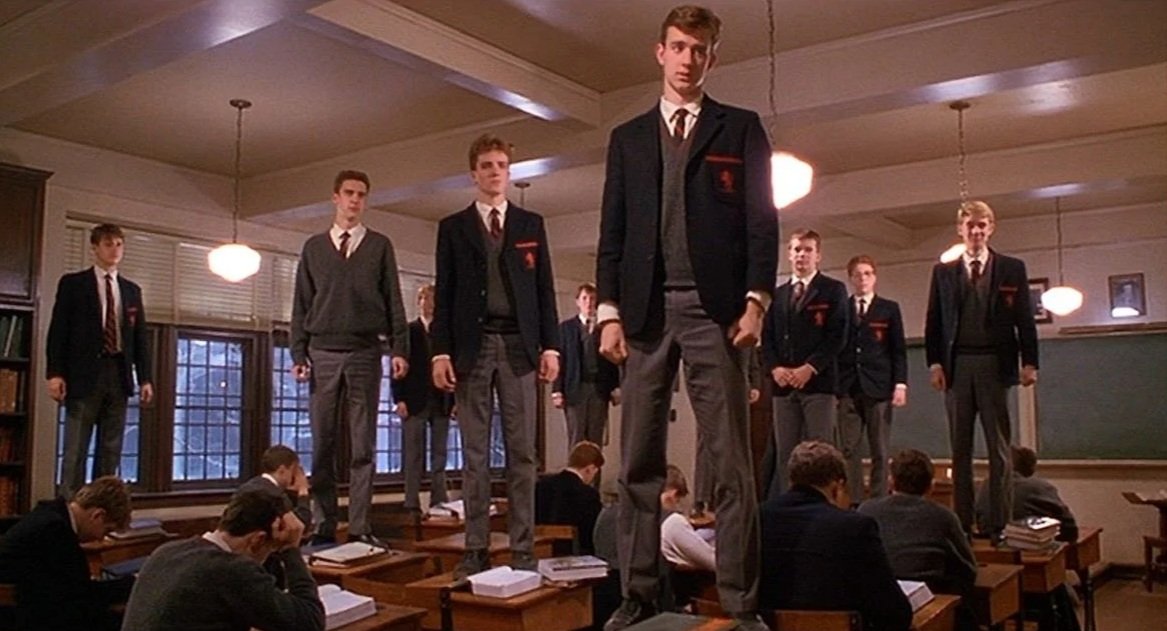
Still from Dead Poets Society (1989). © Touchstone Pictures.
I continue in my performance: “And sorry I could not travel both / And be one traveler, long I stood / And looked down one as far as I could / To where it bent in the undergrowth...”
They are enrapt—all of them.
So, I push toward the end. I lift my chin and stand tall as I drive the poem home. Even I have goosebumps as I feel the weight of Frost’s verse: “Two roads diverged in a wood, and I— / I took the one less traveled by, / And that has made all the difference.”
. . .
Little did I know that this moment of reciting Frost to my students would be one of my last like this. One short month later, COVID happened, and schools across the country were shut down. A few months after that, my body shut down, too, and my life would never be the same. The long and short of it is that I almost died in 2021 due to an aggressive autoimmune disease, post-surgical complications, and sepsis. As a result, I required multiple life-saving surgeries, lost my ability to walk, lost my job and fertility, and just about everything else in between.
The days from 2021 to 2023 were extremely dark. So dark that I lost my will to keep living. I was bedridden for nearly a year in my own home, and the suffering was beyond what I can explain. For obvious reasons, poetry was the furthest thing from my mind for the first time in my life. I didn’t read it. I wasn’t teaching it. And I certainly wasn’t writing it.
I was too sick. I was too lost. I was too angry at God. My illness brought me so low that I began to see poetry as something frivolous. Beauty and the arts were non-essentials, and I saw my life as meaningless.
This is what depression does: it calls into question everything we once held dear, it casts long shadows over everything we love, it lies to us. And all we can see is the Dark, just like the psalmist and poet, Heman the Ezrahite, in Psalm 88, when he lamented, “I have cried out day and night before You... / For my soul is full of troubles, / And my life draws near to the grave... Lord, why do You cast off my soul? / Why do You hide Your face from me? / darkness is my closest friend.”
Perhaps you’ve been there?
. . .
I lived in these shadows, like Heman, until a fateful day in April of 2022. I was very slowly recovering from my third (of four) surgeries. I was finally walking again and had the capacity for the first time in two years to go out into my garden. It was in complete disarray, just like me. Voracious weeds choked out the blooms I once tended. The sight was so upsetting that, despite my trembling, I bent down and began to pull out the invaders right away. Then, I found my shears in the rusty bucket in the corner and began to cut. In one way, my behavior felt cruel—almost brutal. But I knew what needed to be done if my garden was going to have a chance of blooming again.
Stooping in the Florida heat to resurrect my knockout roses, I felt something hit me on the head: it was a revelation like an avalanche of snow. So real and near, and almost audible, I heard the inner voice of God, his Holy Spirit, moving within my weary soul. He said, “See? See what I am doing because of my great love for you?”
Deep down, I knew exactly what he meant, and I began to sob the most cleansing tears of my life. It was his hand all along—the Hand of the Gardener—who had pruned me, ripping away all the places, people, and things that were no longer good and safe for me. It was the Hand of the Gardener who was doing the painful work of bringing me back to life—and not as I was, but as I was meant to be.
As this flood of understanding cascaded over me, the poetry came back. And its arrival was the furthest thing from frivolous. It was a heartbeat. It was a lifeline. It was the language of God.
I shuffled into the house as soon as I could and grabbed an old scrap of paper from my coffee table and wrote down a poem—verbatim—as the words were given to me. The poem became “A Brutal Love,” the mother poem of everything that has come since:
A Brutal Love
In my garden, mid-bloom,
I take the shears
and cut them to their knuckles.
Breaking their necks,
the petals shed like blood
on the sodden earth.
I stand over them.
I am brutal
to the roses,
to the day lilies,
and daisies.
To the gardenias,
I am brutal
and unyielding—
their burnt offerings,
white ash,
like a death before me.
But I know better.
Oh, it is a Brutal Love
that birthed the universe,
demanded Isaac,
offered Job,
and required the Cross!
His is a Brutal Love:
ancient and unyielding,
perennial and unchanging.
Oh, it is a Brutal Love
that sheared me mid-bloom,
that allowed for winter days
of barren grief—
a dark night of the soul
like a death before me.
But He knew better.
In His garden
there is a severe mercy
in His pruning—
a Brutal Love falling down like rain.
And in His season
there is a humming from the earth:
a green bud unfurled.
And He is standing over me.
. . .
That fateful day in the garden saved my life. It gave me the will to live. It gave me a song to sing. I learned firsthand that poetry, like Robin Williams so passionately teaches as Mr. Keating in Dead Poets Society, is the reason we stay alive. In one of his most moving and timeless monologues, Mr. Keating tells his students this about the power of poetry:
“We don’t read and write poetry because it’s cute. We read and write poetry because we are members of the human race. And the human race is filled with passion. And medicine, law, business, engineering, these are noble pursuits and necessary to sustain life. But poetry, beauty, romance, love, these are what we stay alive for.”
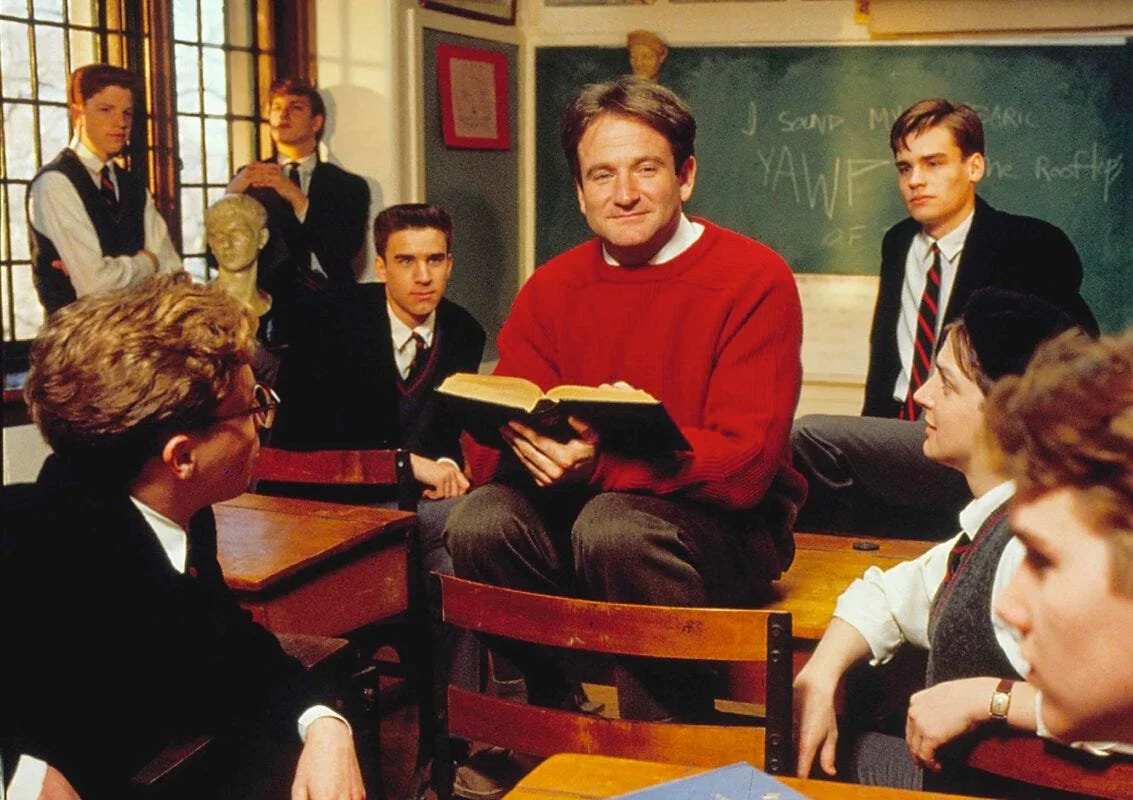
Still from Dead Poets Society (1989). © Touchstone Pictures.
Since the day the words came back to me in my garden with God, I have written hundreds of poems, paving the way for two published collections, Of Wings and Dirt and Exalted Ground: Poems of Praise and Lament for the Living. I have also found a new calling as a professor and community poet at TheWayBack2Ourselves.com, which I founded several months after my divine appointment in the garden. And in the four years since, I have humbly looked on—with awe-filled eyes—as poetry saved thousands of hurting, searching, aching souls just like me.
God wasted nothing.
He never does.
I may never set foot in the classroom again, reciting Frost to stir a room full of teens to life. I may still shed tears over what has been lost and how hard the days are in this dance with chronic illness. But I do know one thing for sure: God used poetry to save my life, and he’s using my poetry to help others, too.
And as Robert Frost so eloquently put it, “...that has made all the difference.”